End of the golden era?

Spot gold prices are expected to post their worst daily performance since June 2013 (down 4.6% at time of writing).

In a year full of asset value surprises, gold has stood out as a clear winner in the COVID crisis. It’s staggering rise since mid-March has divided a lot of analysts. As a traditional safe haven, gold often moves inversely to equities. However, the recent rally in equities appears to be have been matched by steep rises in gold – so what’s different this time?

The answer can be explained by reference to the conditions affecting the current equity market. There is huge discord between valuations and earnings in equities and it’s clear that prices are being propped up by the significant stimulus applied by central banks. Equities have risen continually on the expectation that stimulus will continue for the foreseeable future.

Despite equities rising, the ‘real’ economy is suffering the sharpest and worst contraction on record. It’s on this basis that there is significant demand for traditional safe haven assets, including gold. It’s perhaps no surprise therefore that gold prices have continued to rise, therefore breaking the inverse relationship with equities.

Which way gold goes now will depend on a few factors. Having briefly broken the $2,000 mark some have called the next target price at $3,000. That may seem absurd given the huge increase since the start of the year, however if the COVID crisis continues to drag out well into 2021, there is little in the way of headwinds to prevent this.

I expect todays sell off to be a minor blip in the otherwise continuing rise in gold prices. Perhaps some profit taking was long overdue.
Bears retreat?

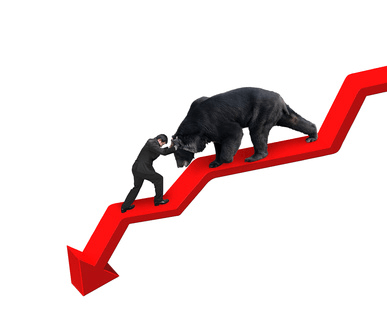
In a week where worldwide markets have risen, can we now conclude the worst is behind us?

Some could be forgiven for thinking that Coronavirus, the subject that has dominated financial market news for months, is a thing of the past and is no longer affecting our major economies. That would be the crude analysis of an investor who looked purely the fundamentals of how the markets have reacted over the past week.

Consider the following stats for the week ending 10th April:

  • FTSE 100 risen by 7.9% (427 points)
  • Euro STOXX 50 index risen by 7.1% (191 points)
  • S&P 500 risen by 6.3% (163 points)

These significant gains are occurring at a time when the number of cases and deaths across Europe and the US has skyrocketed.

Why are markets rising?

There are various reasons why this may be occurring…

Bargain hunting

The recent market performance has seen markets overall falling in excess of 20% from their market highs at the start of 2020. Some sectors and stocks have seen their share prices collapse 50% to 60%, or more in some extreme cases. Travel, Leisure, and Airline stocks have been particularly badly hit as these sectors have ground to a halt.

As an investor, does that mean these companies will be 50% worse off in the future? In a post-coronavirus world, will the demand for air travel be worse off or better? These are the sorts of questions a bargain hunter investor looks for. If they are convinced their stock of choice can ride out the crisis and remain solvent, then this type of event presents an opportunity to invest at a discounted price.

Key risks are: a) the company has liquidity issues and potentially fails; b) the market suffers a protracted easing of restrictions, further delaying normality; or c) the market falls further below the price you jump in at.

Dead cat bounce

An aptly put way of describing a “dead” market (i.e. one that is still on the sell side) but finds some steam to rise again, despite the continuing signals that the market is likely to fall. In my view this resonates quite strongly with the current situation, particularly in the absence of positive data that may indicate a turn in fortunes towards the buy side.

Positive momentum may be sustained for a short period before a further fall is recognised, pushing markets even lower than has been seen over the past month. Short term investors can often suffer losses by jumping into the market at this point in time, by assuming that the worst is behind us.

Bottoming out

This not so technical term points to the market “turning a corner” from the bottom of the fall. Considered even by experienced investors as the hardest point in time to predict, it signifies the point where relative pricing-in of negative news/results/metrics hits a tipping point, where the evidence appears to show that the sell-off has gone too far. The curve on the charts hits the low point and retraces its steps in a U-shape fashion.

Whether the actions of the past week represent the end of the bear market is the million dollar question that only time will tell.

The journey begins….

Thanks for joining me!

Our favourite holding period is forever. — Warren Buffett

post

Welcome to my blog! My goal is to provide insights and opinions on financial markets and investing, from the perspective of a fresh-eyed millennial.

As a generation, millennials are perceived as being unable to invest through lack of savings (or interest) in comparison to older generations. Many studies show that significant wealth will be inherited by millennials. For those that know nothing about investing, how to invest or how financial markets operate – that may prove a daunting task when the time comes.

I will aim to guide you through my take on the markets and hopefully encourage people to see that the markets can be accessible to all.